
Access Control · Planning guide
What Is Commercial Access Control? A Practical Guide for Atlanta Properties
Commercial access control is the hardware and software that decides who can open a door, gate, or amenity entrance — and when — then records that event.
A useful system assigns credentials to people, not to a shared secret. Staff, residents, members, vendors, and guests get the doors they need, on a schedule, and a manager can add or remove access from a browser or phone without collecting keys or changing a community code.
Media Nexus designs and installs cloud-based access control for offices, multifamily buildings, HOAs, houses of worship, and other commercial properties across Metro Atlanta and Georgia. You can start with one door. You do not have to rebuild every opening on day one.
See the access control installation service for platforms, intercoms, and project examples.
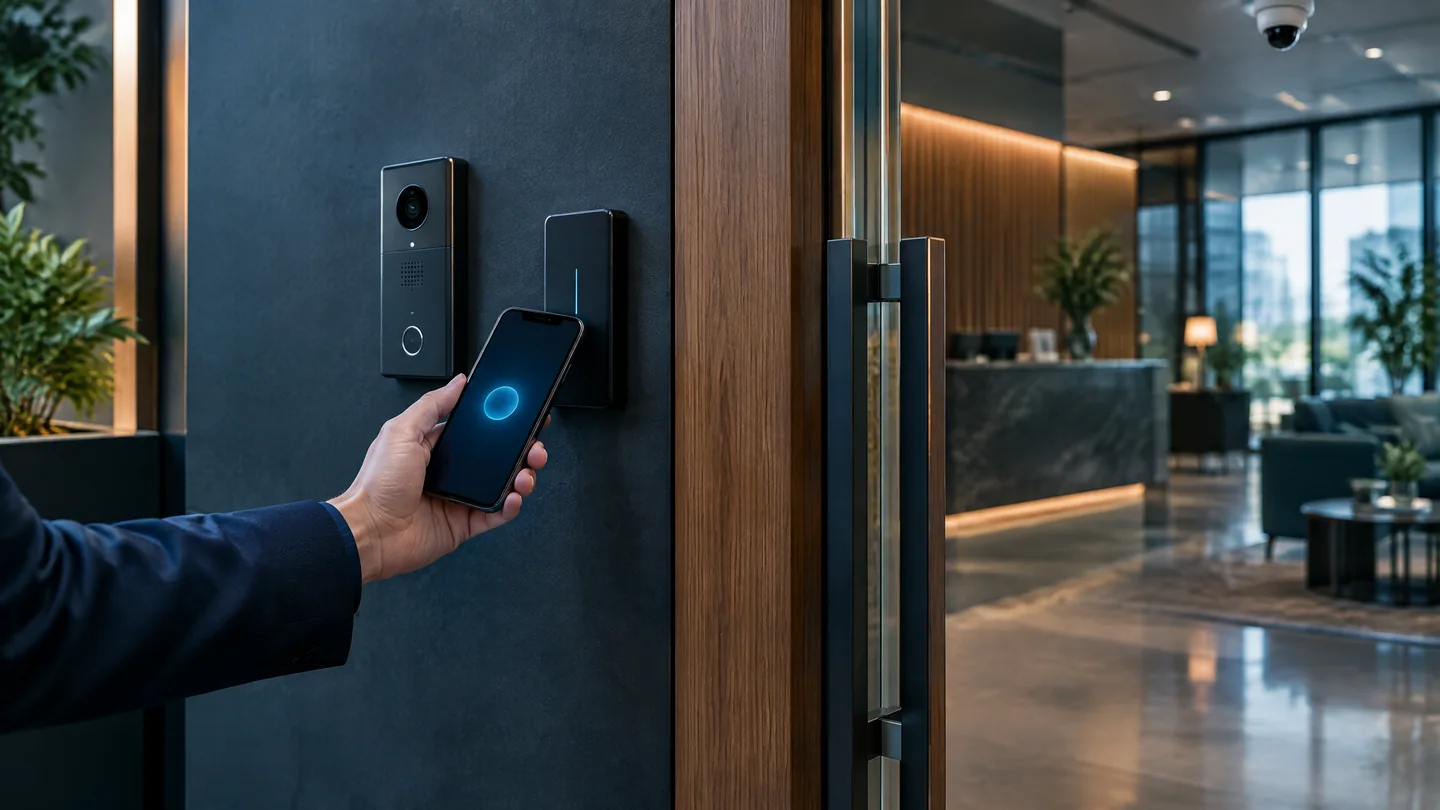
What a commercial access control system includes
Scope depends on the property. A practical project usually considers these layers:
- Users, groups, and schedules — staff, residents, members, vendors, and guests, each with the doors and hours they actually need.
- Credentials — mobile credentials for everyday users; cards, fobs, keypads, or PINs where they still make sense; temporary PIN or QR access for visitors.
- Readers, locks, and door hardware — the physical opening: reader, strike or lock, request-to-exit, and a door that latches when it should.
- Controllers and cloud software — the panel or controller at the property and the dashboard used to add people, change schedules, and review events.
- Video intercom where visual verification matters — a call to a phone, a face at the door, and an unlock from the same workflow.
- Network, cameras, commissioning, and training — connectivity the system can live on, optional camera links for door events, testing of real arrivals, and training for the people who will manage it.
A single pool gate may need only some of these. A campus with a vehicle gate, lobby, and amenity rooms will need more of them planned together.
Where commercial access control is used
In corporate offices, suites and after-hours access are organized by role — staff, cleaning crews, and visitors — instead of a front-desk key ring.
Multifamily buildings use individual resident credentials for entries, amenities, and package rooms so a move-out does not require a community rekey.
HOA and gated communities put the vehicle gate, pedestrian gate, clubhouse, and pool on schedules and credentials that the board or manager can change remotely.
Houses of worship can keep doors locked on weekdays, open automatically for services, and avoid propping an entrance for volunteers.
Education facilities assign access by role and need a way to restrict entry quickly.
Fitness and sports venues separate member hours from staff-only doors and stop relying on a code written on the front desk.
Retail and hospitality properties typically need staff and stockroom control with an audit trail, not a customer-facing lobby turnstile.
The common requirement is not the number of doors. It is that the people who manage the property can change access the same day a person joins or leaves.
How to plan an access control project
Start with how the property runs today, not with a reader brand.
- List every opening that matters — vehicle gates, pedestrian gates, lobby doors, stairwells, amenities, package rooms, and staff-only rooms. Note which ones already have electric locks.
- Name the user groups and their hours. A resident, a board member, a pool vendor, and a Sunday volunteer are not the same schedule.
- Decide how people will prove who they are. Phones for daily users; cards or fobs as a backup; short-lived PINs or QR codes for guests.
- Check power, lock hardware, and network at each door before promising wireless everything. Some doors are easy to wire. Some are not.
- Decide whether a visitor should be seen, not just admitted. That is when a video intercom belongs in the same project.
- Plan who administers the system after handoff — property manager, board member, office manager — and train those people, not only the installer.
If cameras should explain a door event, include security cameras in the same conversation. If controllers and intercoms will sit on the building network, include data networks and Wi-Fi.
What problems a good installation is meant to solve
Typical symptoms: a code that half the neighborhood knows; keys that were never returned; a pool gate that stays on one PIN for years; a manager who drives to the property to let in a contractor; no record of who opened a door after hours.
Those are identity and operations problems. Adding another lock without individual credentials usually repeats them.
Media Nexus starts with how the property actually operates — who needs which door, at what times — then plans readers, controllers, credentials, intercoms, and the network as one system. Read more about the access control service.
Access control installation in Atlanta and Georgia
Media Nexus Inc is based in Marietta, Georgia. Founded in 2007 by Eyal Kattan, it focuses on commercial environments and serves Metro Atlanta and locations across Georgia, including Savannah, Augusta, Columbus, and Macon.
An organization can request a single-door or single-amenity installation without committing to every opening on the property.
Georgia examples include The Willows HOA in Marietta, where pool and gym access moved from shared keypad codes to individual credentials on one PDK account; Tuxford HOA in Alpharetta, with cloud access on a pedestrian pool gate and clubhouse; and TBT in Roswell, where doors, a vehicle gate, and video intercom share a cloud platform.
How Media Nexus approaches access control
Work starts with users, groups, and schedules. Credentials are chosen to match how people actually arrive. Video intercom is added when someone should see the person at the door. Cameras are linked when a door event should open the matching clip. Wiring, programming, commissioning, and training are part of the same project — not an equipment drop-ship.
Platforms are specified to the property. Media Nexus designs and installs cloud systems such as ProdataKey (PDK) and Brivo, and intercoms such as BAS-IP, Aiphone, and Comelit, according to the openings, users, and support needs — not a single product for every site.
See the access control solution for service scope.
Frequently asked questions
What is commercial access control?
Commercial access control is a planned system of credentials, readers, locks, controllers, and software that grants or denies entry by person, door, and schedule, and keeps a record of those events. It is built for shared properties, not for a single household lock.
How is it different from keys or a keypad code?
A key or shared code is a secret that can be copied or passed along. Commercial access control assigns access to a person or role. When that person leaves, their credential is turned off. Everyone else keeps working.
Can Media Nexus install just one door or gate?
Yes. A pool gate, clubhouse door, or office suite can be a complete first project. Additional openings can be added later on the same platform when the design allows it. Building-wide coverage is not a prerequisite.
Can we keep existing cards and fobs?
Sometimes. It depends on the credential technology already in use and the readers being specified. The useful first step is to identify the existing cards and whether they can be enrolled in the new system. If they cannot, new credentials are issued and the old ones are retired on a schedule.
What happens if the internet goes down?
Most commercial controllers keep granting access from rules stored at the door or panel. Cloud features such as remote management and live event review wait until the connection returns. The exact offline behavior depends on the platform and how it is installed. Ask for that behavior in writing for the system you are buying.
How does a video intercom work with access control?
The intercom lets staff or residents see and speak with the person at the entrance, then unlock from a phone or station. When the intercom and access control share a database, visitors and credentials are managed in one place instead of two logins.
Can several buildings be managed together?
Yes, when the platform is cloud-managed and each site is set up on the same account structure. That is a common reason offices, multifamily portfolios, and HOAs move off standalone keypads.
Where does Media Nexus install access control?
Media Nexus serves Metro Atlanta and Georgia, including Savannah, Augusta, Columbus, and Macon. It focuses on commercial environments and welcomes projects that start with a single installed opening.
Next step
Tell us about the property
Describe the openings, who uses them, and what goes wrong today — lost keys, a shared code, vendors at the gate, or no record of after-hours entry.