
Commercial AV · Planning guide
What Is Commercial AV? A Practical Guide for Atlanta Organizations
Commercial AV is the displays, sound, microphones, cameras, video sources, controls, and wiring used to help people communicate in shared spaces.
A useful system is planned around the room and its users, then installed and tested so staff can start a meeting, run a presentation, or manage background media without a technical scramble.
Commercial AV can be one professionally installed system—for example, a training-room display and audio setup—or several systems coordinated across a property. Media Nexus works on both. You do not have to buy a campus-wide project to get a room that staff can operate.
See the commercial AV installation service for scope, related systems, and project examples.
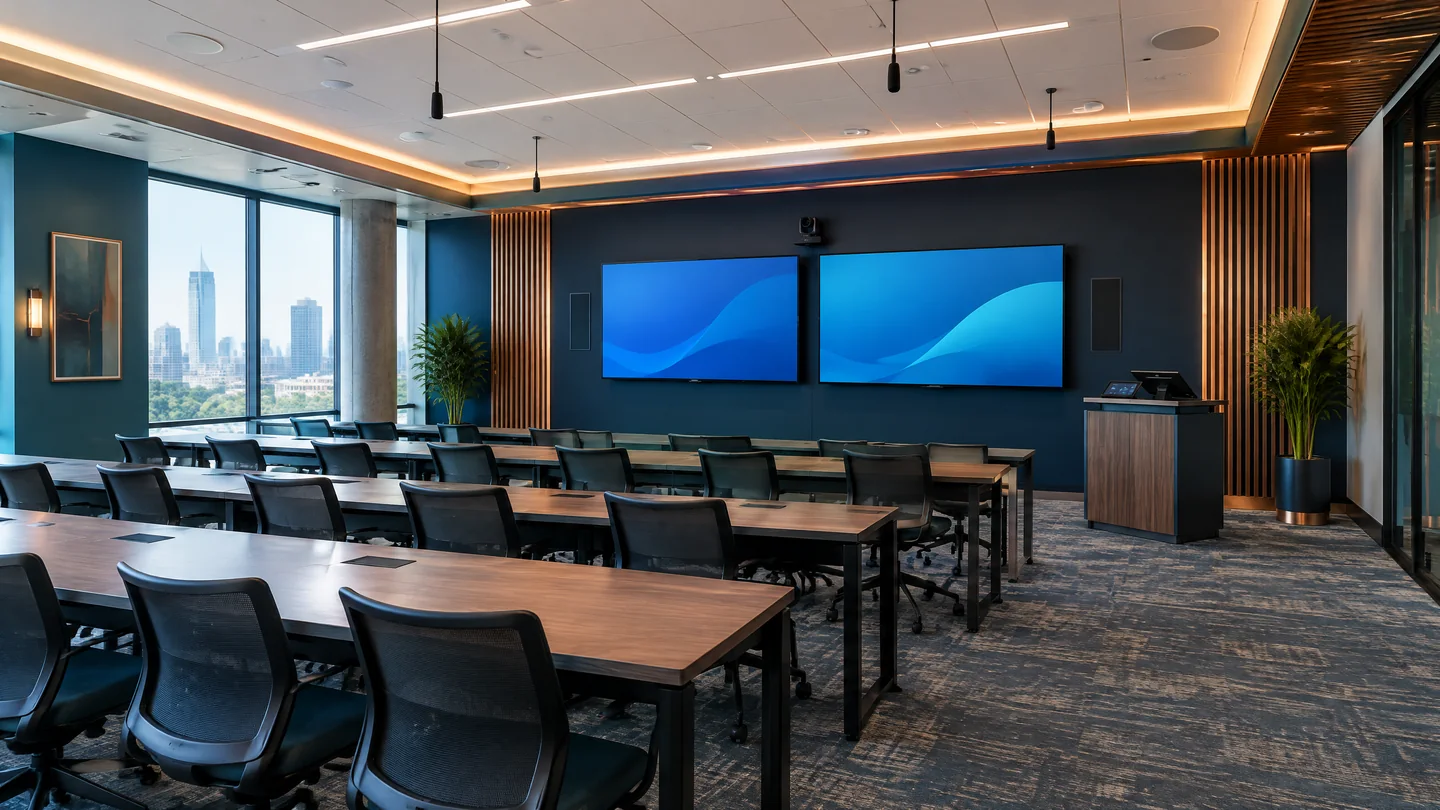
Commercial AV vs. consumer electronics
A home TV and speakers can be appropriate in a private office or break room with one regular user. In a shared organizational space, the decision also depends on operating hours, lighting and acoustics, who needs to use the equipment, how it will be controlled, and who will support it.
Commercial products often include features for those conditions. The right choice is still application- and model-specific. Do not decide by the label on the box alone.
Swipe horizontally to compare the columns.
| Planning question | Typical home setup | Commercial AV project |
|---|---|---|
| Who uses it? | A small, familiar group | Staff, guests, volunteers, or rotating presenters |
| How is it operated? | Individual remotes and direct inputs may be enough | Controls and input choices should be clear to a new user |
| What needs to connect? | Often one screen and a few sources | May include conferencing, distributed audio, signage, room controls, or the network |
| How is it installed? | Limited mounting and cabling needs | Mounting, signal paths, power, network, and access for service are planned together |
| How is it kept working? | Product support depends on the purchase | Product coverage, installation workmanship, training, and ongoing support must each be defined |
| Warranty | Often 1–3 years on consumer products. Some warranties are written for home use and may exclude or limit commercial duty. | Often 2–5+ years on commercial-rated equipment. Some product lines offer 7–10 years or limited lifetime on specific items. Confirm the written terms for the models specified. Installer support is separate and depends on the project agreement. |
An equipment warranty is not automatically a promise to cover mounting, cabling, programming, training, or future service. Those installation and support commitments should be written into the project agreement. Warranty length varies by manufacturer and product; treat the ranges above as typical planning context, not a guarantee for every component.
What does a commercial AV system include?
The components depend on what people need to do in the space. A practical scope usually considers these six layers:
- Displays or projection — placement, viewing distance, glare, brightness, and the content people need to see.
- Audio and speech clarity — microphones, speakers, amplification, and tuning suited to the room, not just louder sound.
- Sources and distribution — laptops, conferencing devices, media players, or signage content, plus the path that gets each signal to the right destination.
- Control — a simple way to select a source, start a meeting, adjust volume, or turn the room off.
- Infrastructure — safe mounting, power, cabling, network capacity, and space to maintain the equipment.
- Commissioning and handoff — testing the real workflows, documenting the setup, and training the people who will use it.
A single-room installation may involve only some of these elements. A larger property may need several rooms or zones to work together. Both deserve a clear installation plan.
Where is commercial AV used?
In corporate offices, meeting rooms and training spaces need presentations and hybrid conversations that start on time.
In schools and education facilities, classroom displays and sound need to work for different instructors throughout the day.
Houses of worship rely on intelligible speech and manageable controls for staff and volunteers.
Hospitality properties use AV in lobbies, meeting areas, and event spaces;
restaurants may need separate audio zones or digital menus. Fitness and sports venues depend on sound and displays across active spaces.
Multifamily buildings can use AV in lounges and other shared amenities, while retail properties may need background audio and customer-facing displays.
The common requirement is not the size of the project. It is that the installation suits the space, the schedule, and the people responsible for daily operation.
How should you plan a commercial AV project?
Start with the task, not a product list. Ask what a staff member should be able to do in the first 30 seconds after entering the room.
- Document the room and its users. Note seating, sightlines, noise, accessibility needs, usual operators, visiting presenters, and existing equipment.
- Choose the primary use. Is this for in-person presentations, hybrid meetings, announcements, music, signage, or a combination? The answer affects cameras, microphones, speakers, and controls.
- Check the site before selecting hardware. Review power, mounting surfaces, cable routes, acoustics, light, and network capacity. If there is an existing system, identify what can be retained.
- Design the everyday workflow. A substitute employee should know how to start, select an input, adjust volume, and shut down without relying on one expert.
- Budget for the whole installation. Include equipment, mounting, cabling, configuration, programming where needed, testing, staff training, and the agreed support plan.
For a conference room, meeting-room planning may be the best next step. If the project spans several rooms, networking and Wi-Fi and automation and control may also need a place in the plan.
What problems should a good installation solve?
You may recognize the symptoms: meetings start late because nobody knows which input to select; only one employee knows the controls; people at the back cannot hear clearly; or new connected devices overwhelm the network. Those are workflow and infrastructure problems, not just shopping-list problems.
Media Nexus starts by mapping what needs to happen in the room. The team can then specify the display and audio, coordinate the wiring and network, install and configure the equipment, test the actual tasks, and train the people who will run it. Read more about the commercial AV installation service or the problems we solve.
Commercial AV installation in Atlanta and Georgia
Media Nexus Inc is based in Marietta, Georgia. Founded in 2007 by Eyal Kattan, it focuses on commercial environments and serves Metro Atlanta and locations across Georgia, including Savannah, Augusta, Columbus, and Macon. Its work includes commercial AV alongside security, digital signage, networking, access control, and automation.
An organization can request one system installation without committing to a building-wide integration project. Learn about Media Nexus.
An Atlanta example is the Bridge Commercial Lenox training room and lounge. Media Nexus installed presentation and conferencing in the training room, added AV in the adjoining lounge, and brought day-to-day operation onto an RTI wall-mounted touchscreen so staff could run both spaces from one control point. The case study includes project photos and installation detail rather than a generic claim.
How Media Nexus approaches commercial AV
The work begins with requirements and design: what the room is for, who uses it, what sources matter, and what support the team expects. Displays and video are then planned around visibility and the signal path. Audio and speech intelligibility are planned for the actual room and audience. Finally, installation, integration, commissioning, documentation, and training bring those choices into a system people can operate.
That process can apply to one meeting room, one professional audio installation, or a set of connected spaces. See the commercial AV solution for the service scope and related installations.
Frequently asked questions
What is commercial AV?
Commercial AV is audio and video planned for shared organizational spaces such as meeting rooms, classrooms, sanctuaries, lobbies, and amenity areas. It can include displays, microphones, speakers, cameras, sources, controls, and the cabling and network connections needed to use them.
How is commercial AV different from buying a TV and speakers?
The difference is the planned use and installation. A shared room may need longer operating hours, multiple users, simple source selection, clearer speech, network connections, and a defined support path. A consumer TV and speakers can still fit a private office or break room with one regular user. The appropriate equipment and its terms depend on the particular application and model.
Can Media Nexus install just one AV system?
Yes. Media Nexus welcomes an individual system installation, such as a meeting room or professional audio setup. It also handles projects where several technologies need to work together. Building-wide integration is not a prerequisite.
Can an existing AV system be upgraded?
Often, yes. First identify what still works, what users struggle with, and whether the cabling, network, controls, and existing equipment can support the new use. That assessment can show which components to keep and which to replace.
Does Media Nexus design and install systems, or only supply equipment?
Media Nexus plans and installs commercial AV, including equipment coordination, wiring, configuration, testing, training, and post-installation support. The scope is built around the environment and agreed project requirements rather than an equipment-only shopping list.
Can AV work with signage, room controls, or other building systems?
Yes, where the equipment, network, interfaces, and project scope allow it. A useful planning conversation covers how people operate the space and which systems should share information or controls. Not every project needs every system connected.
Is the equipment warranty the same as installation and support?
No. The manufacturer’s written terms govern eligible equipment coverage, which can vary by product and by whether the use is residential or commercial. The installer’s agreement should separately describe installation workmanship, programming, training, and any ongoing service. Ask for both sets of terms before approving the project.
Where does Media Nexus install commercial AV?
Media Nexus serves organizations across Metro Atlanta and Georgia, including Savannah, Augusta, Columbus, and Macon. It focuses on commercial environments and welcomes projects that need only one installed system.
Next step
Tell us about your space
Planning one AV system or several? Tell us what you need the space to do, and we’ll help you plan an installation around your needs and budget.